

Unlocking my lockdown joints with a 5K walk.
This morning I just needed to get walking again. Whilst I have walked 30 minutes locally every day through lockdown, I can feel how tight my joints are and my unusual gait is more pronounced. Which means my muscles are working harder - and they ache. A lot.
I know there are two things which, in combination, help me manage my hip dysplasia and painful knee: Swimming and Striding. Since I still can’t get into the pool to do the laps I love, I decided to pack my poles, don my walking boots and drive to somewhere I could walk a bit further, and a bit faster with the help of the poles. My target was to walk 5K – to also support my friend Caitlin Limmer and the Bearcat Running Club as today was supposed to be the annual Turks Head 10K.
Just before lockdown I moved from Twickenham to Walton-on-Thames. So it took just 17 minutes to drive to Ockham Common, park up, and start walking through the woodland. It was just what I needed! As I got out of the car I could hear the birds and smell the trees (the recent rain really helped) and I immediately felt my body relax. And I was surprised how quickly, with the help of my trusty poles, I was able to get into my stride.
I love woodland walks. I’m always reminded of walking with my parents up to Lockerbrook Farm above Derwent Water in the Peak District. Thankfully today was much flatter but equally beautiful.
I’ve never been to this Surrey Wildlife Trust land and was struck me most was the variety of terrain. I took a path through the bracken, under the tall canopy of deciduous trees and quickly got to the edge of a lake. There I could see baby frogs hopping towards the water through the rushes. I made my way into the forest along wooden planks above the bog, and into the beautiful English woodland. Here amidst more bracken were beautiful rhododendrons in dappled light. Eventually I reached a small road, across which was the most amazing wild-flower meadow. I stood and watched the butterflies playing with the tall daisies in the morning sun. I made my way back through the woodland to the car but since I’d walked less than 4K I decided to take another path. And I’m so glad I did. Here I was amongst tall conifers and walking uphill on fine, chalky ground, to a clearing. And the landscape changed again. Suddenly I was amidst heather, birch saplings and small Christmas trees! And a big sky.
After a round loop I made it back to the car having walked over 5K. It was enough to stretch my joint, but not too much for a first outing. I have managed to book my first osteo appointment in 2 weeks’ time and hope to start swimming in July to really re-align my body.
Because now I have the walking bug again. Which feels simply wonderful.


Hip-py New Year!
Wow. What a year 2018 has been for me and my hips. I celebrated my Birthday three days ago, 47 years after I was born with hip dysplasia. This time last year I never imagined that I’d have walked a 10K race and 24.5 miles of the South Downs Way. Yet I have, and 2018 has been a thrilling year.
I started walking more this year really as a form of therapy. It all started in March when I found it hard to walk up Back Tor in the Peak District. I realised how much I protect myself and how I struggle to find the right the balance (literally and mentally) between accepting my limitations and pushing myself.
In this year of walking and writing, I’ve also realised how little I knew about DDH – a condition I’ve had all my life. So part of my journey this year has been reading about hip dysplasia and connecting with other people who have the same condition.
Here are 5 things I’ve learned:
- 1 in 10 babies are born with hip instability, 1 in 100 are treated for hip dysplasia and 1 in 500 infants are born with completely dislocated hips. In short, it’s actually quite common. (IHDI figures)
- You’re 4x more likely to have hip dysplasia if you’re female, it’s most common in the left hip and only about 20% of cases are bilateral - i.e. both sides like me. (HipWomen stats)
- A baby’s hips are mainly cartilage and so it’s about 4-5 months before everything is visible on an X-Ray. If the hips aren’t actually dislocated at birth, it can be hard to detect. One of the biggest surprises to me is the number of people who are only diagnosed as adults when they start to develop groin pain. (Sutherland/West)
- To this day, no one knows what causes it. There is a higher incidence with breach birth (which I was), certain positions in the womb, very large babies (I was actually a chubby baby, believe it or not). But these are all correlated risk factors not definitive causes. (Sutherland/West)
- The best way of thinking about hip dysplasia (from Sutherland/West) is to imagine an egg on a shallow spoon (wobbles around) rather than sitting snuggly in an egg cup (which is more like a normal hip). Ironic then that egg and spoon is the race that all the non-athletic kids did at my school sports day. Including me, which was pretty hilarious; precarious actual egg on spoon carried by someone who couldn’t walk straight. Let’s just say we learned quickly to hard boil the egg first!
Walking the Souths Downs Way and a week
on the Hoffman Process both helped me see the impact my differently-abled hips
have had on my emotional and mental health.
Good and bad.
I have a pretty strong will to achieve and a very strong
desire to prove I’m capable. That determination is not a bad trait, but I’ve
learned this year that accepting what’s happening right now, and what I really
can’t do, is also helpful. Like my first
day walking 9 miles from Winchester. Not
likely to make that mistake again…
I also have a fear of abandonment and reluctance to ask for
help from others. Until Hoffman
I had never really thought about how many of my attachments were broken when I
was very young - in and out of hospital and experiencing bodily trauma. I now
recognise the impact that has had on my willingness to rely on others.
Of course, the South Downs Way has been the perfect place to consider these impacts. Each weekend has been a true exercise in mindfulness and self-compassion. Often just me, birds, raindrops, sheep and the occasional tractor.
In June 2018 I walked the Turks Head 10K in Twickenham with the amazing, supportive Bearcats Running Club community – collecting my first ever medal. I then did two test walks before taking on the first two ‘legs’ of the South Downs Way – Winchester to Exton in October and Exton to Buriton in November. It’s been an amazing journey so far through amazing English countryside.
In 2019 I will continue my walking - slowly making my way
over the Downs to Eastbourne. Hopefully
this year you’ll get to meet a few friends along the way, and maybe a few other
‘hippies’ who’ve reached out to share their amazing stories with me too.
Until then, thanks for all your love and support for my
first year @WalkingJill.
And a very Hip-py New Year to you all xx
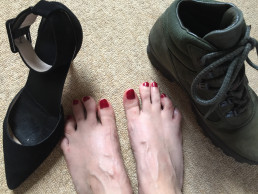
If the shoe doesn’t fit... orthotics and hip dysplasia
Walking my first 10K for Steps last month taught me a couple of valuable lessons. Firstly, I need to build up my leg strength, particularly around my knees, or I’ll never manage the hills and rugged terrain of the South Downs Way. And secondly, I need to find some comfortable walking boots that my orthotics fit into properly, so I don’t get blisters.
This second realisation makes my heart sink. Oh no, not shoes….
Shoes have always been my personal nemesis. Practically and emotionally.
I was born with hip dysplasia (DDH). My pelvis is incomplete, crooked and I have legs that are different lengths. I also inherited some ‘unusual’ feet that are different sizes - and a left ankle that turns out a bit like Mary Poppins. I wear orthotics to correct my leg length and knee position so practically speaking, pumps or shoes that are light and tie tightly to my feet are the best.
Emotionally – well, like many women I drool over the sexy heels on display in the LK Bennett window. But shoe shopping just isn’t fun. Unlike Cinderella, the shoe rarely fits on either foot and the need to insert orthotics writes most girl-shoes off the list. When it comes to dressing up girly, I often feel more like the ugly sister than the fabled princess in waiting.
I didn’t mind shoe shopping as a kid. My orthopaedic consultant insisted on good shoes that fastened well to my feet so we always went to Clarks in the Co-op department store in Sheffield. They had animated models of the Animal Kwackers there, who I loved. Like Boots and his silver platforms there was a blingster in young Jill - so I always chose the shiny shoes with gold braiding. Happy memories.
The psychological challenges started for me as a teenager. Wearing stilettos was a marker that you were growing up and at that age I become hyper-conscious of the image that heels = sexy. So I persevered with my heels and fishnets at school (it was the 80s in a school with no uniform) because I wanted to fit in. And I wanted boys to look at me like they did the other girls. In reality heels just accentuated my limp and made me walk badly because they’re less stable.
Yet to this day I still dread dressing up for a night out where women wear sexy high heels with their dresses. My own inability to stand up, let alone walk or dance in them, makes me feel like I'm not quite cutting it as a woman. Of course, this is just my own perception - a story I've invented in my own head. But it’s honestly what goes on in it! Rationally I know it really doesn’t matter and I’m lucky I can walk. But emotions are funny things….
I was recently with a group of girlfriends who were sharing their first childhood memories. Ironically, mine is about shoes. My pre-school playgroup used to streamline the rush for bags and coats at the end of the morning, by sending you to get them according to shoe colour. “Everyone with red shoes. Now everyone with brown shoes.” It’s a happy memory for me because I got to go up on my own. I was the only one in blue shoes and I simply loved that I was different. I was differently-abled and differently-minded.
Thankfully stilettos aren’t the rage along the South Downs Way. So right now it’s about finding boots that can support but not cripple my funny ankles. And getting good orthotics that are fitted properly inside them. Since my 10K I’ve been consulting with a chiropractor and my podiatrist, and I’m being fitted for new orthotics next week.
The more I explore my life with hip dysplasia (DDH) and what goes on in my mind about that, the more I see that we’re all differently-abled. We all have things we’re not good at or a bit paranoid about. And let’s face it, you don’t need to have hip dysplasia to be crap at walking in heels!
My pledge is to try and be more like 3-year-old Jill - newly walking in her blue shoes. Walking differently. And proud of it.
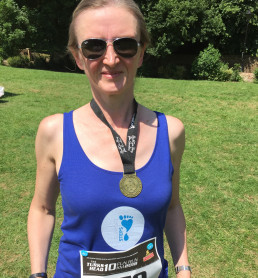
My 10K Walk. Fitting in by Standing Out.
Yesterday I walked my first ever 10K race.
I consider myself lucky. Despite being born with hip dysplasia, as a child I wasn’t bullied much about my walk, or even about my legs with their knobbly knees and surgery scars. Like many people who have a weakness in one area (for me, sports) I found areas that I was good at and could compete in. I focused on being a bit of a swot at school and singing with a girls’ choir (if you’re thinking bookish-choirgirl you’re about right and the dating profile that generated is a whole other blog post!).
The downside of focusing only on what I’m comfortably good at, is that for a long time I avoided situations where I had to hang out with the ‘sporty’ kids. I’d told myself I didn’t fit and would have to ‘compare’ myself with people who were very physically able. So I’d spare my emotions and protect my body by playing it safe and not joining in. I got fairly good at swimming because it’s something you can do easily alone, and I braved aquafit classes because they’re good for the injured. And that was my keep-fit comfort-box ticked.
Yet I have a distinct memory of being at primary school and insisting (to probably mildly-terrified teachers) that I would climb the tall A-frame or get on the beam in PE class, because I was going to do what everyone else was doing. Or at least as close to it as I could. I’d just do it the Jill way. About a year ago I wondered - “where did that little girl go”? It struck me that she had it about right. Of course, at 6 you don’t understand the risks, at 46 you do. But risk and reward go together.
So a year ago I joined a local running club. I’ve never been able to run really because my hips are at very different levels and my knees and ankles are also mildly deformed. But I’d learned from friends that they had a walking group and went along. I remember my first Sunday and how afraid I was. Afraid that I’d physically hurt myself, but even more fearful of the impact on others. What if I was too slow, what if I held others back from pushing themselves? Standing out for all the ‘wrong’ reasons (wrong in my head, not theirs of course).
I consider myself lucky. Because the Bearcats was the perfect running club to do this. I was amongst people of all running and walking abilities who just took me in their stride. Some run marathons; many do not. Some of the walkers used to run until their knees stopped them; some are walking first to build up to running something like a 10K; others are just injured for a week or two so walk instead. Everyone is differently-abled. They encourage me to push myself, just as they push themselves too. I’ve never felt more included, anywhere.
And so yesterday, nearly a year on, I walked my first ever race – the Turks Head 10K fun run. I did some fundraising for a small charity called Steps, but mainly I did it to push myself. And to join in with the sporty kids rather than always watch them.
Just like everyone who was doing their first 10K (or even their fifth!) I had to train to build up my distance and pace. I started walking 4K twice a week and then built from there. Each week I stepped up the distance or the pace and every time I did, my knees or my hips ached more or my neck locked to compensate for the instability of my funny walk.
Yesterday, I woke up with neck pain and a locked left shoulder. OK, so that felt less lucky. Yet I completed the race in just over 1 hour 45 minutes. I was way behind everyone, it started to hurt through the last few kilometres and I’ve had to have my neck clicked by an osteopath today. But I suspect I’m not the only one who’s feeling sore today.
I crossed the finish line to people cheering me, just like everyone else. I did it the Jill way and I fitted in, by standing out. And I loved every minute.