
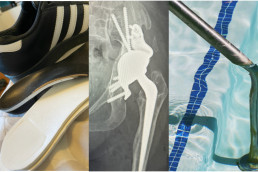
The specialist therapy jigsaw for hip rehab: physio, hydro, podiatry
It’s now 9 weeks since my complex hip revision surgery. In the last few weeks I’ve seen various therapists who each deal with a different part of the rehab puzzle: Physiotherapy, Hydrotherapy, Podiatry and Chiropody. With a lifetime of hip dysplasia, bringing this together requires a slow and steady approach that’s a lot more tortoise than hare….
Physiotherapy
I’ve been seeing a physio every 2-3 weeks since my surgery, and physio is definitely the centre of my recovery plan. Whilst the surgeon sets the guardrails around my rehab (the pace and limits to protect the hip whilst it stabilises) it’s my physio who I see as the key person guiding my progression. More recently my exercises have been about getting specific muscles to engage that will restore particular day to day movements; sit to stand, sliding and lifting my leg independently, stepping up and down, bending my hip fully to 90 degrees in some positions. And walking reciprocally with my crutches (mimicking a more natural way of walking and taking more weight through my operated leg).
I found this physiotherapist over 15 years ago and her knowledge of how different my ‘baseline’ is to a normal set of hips and knees has been critical. She also gives me advice for hydro and podiatry and I let them all share my personal data/liaise if they want to.
Hydrotherapy
After my last post-op consultation I was allowed to start hydrotherapy. This is both a relief (I’m a swimmer and I’m really missing the water) and extremely tiring. My first session was overwhelming, both physically and mentally as I was so anxious not to do ‘too much’. I had my second session yesterday, which was much better because I knew I’d been OK after the first one. But still tiring - I slept so well last night and I’m sore today. I always progress faster once I start hydrotherapy because the support from the water (and so being 50% not 100% weight bearing) means I can make more movements for longer - stand/sit, walking, cycling movement, leg raises etc. We are being a little cautious about some movements like abduction, and not adding resistance like flippers yet. But I can do so many more repetitions of my exercises in the water. Plus I get a proper shower at the end, which still feels like a luxury until I’m allowed to step into a bath to take a shower at home.
Podiatry (orthotics)
I first started with orthotics a few years after my initial hip replacement. My knees, ankles and feet are all part of my unusual biomechanics - none of them are ‘normal’ and there’s a lot of hypermobiity (ie they’re loose, so add additional instability to way I walk). Post my hip replacement, I got some custom orthotics for the first time in both my shoes - to help correct a small (1cm) leg length discrepancy, and to help stabilise the position of my knees and feet when I walk. After my right knee replacement, the leg length discrepancy became more acute (more like 2.5cm) and so for the last 3 years I’ve had an outer shoe raise as well as inner orthotics. It’s amazing what can be done by a good practitioner (gone are the days of the big black surgical boot).
After my recent hip revision surgery, my new metal hip socket is a bit bigger and less worn, so I’m back to around 1cm difference again. It will take about one year of continuous improvement before we know exacely where it will end up - so I don’t yet want to spend money on a new permanent solution (custom orthotics aren’t cheap).
So, last week I saw the podiatrist (who I’ve also been working with for a number of years) for an interim solution. A couple of ‘shims’ to about 8mm (think thick bits of insole custom cut to size) under my most recent inner left orthotic, has allowed me to remove the outer shoe raise. I’ve only had this solution for three days yet I can already feel the difference - the position of my left knee and ankle when I walk is much straighter and more stable. This will become really important when we get to walking without crutches, and right now, it helps with physio exercises like sit to stand from a chair, because my knee can take more weight. My hip muscles are a little sore as they adapt to a slightly different (correct) use of the muscles, which have all been traumatised by the surgery.
Chiropody
Not an obvious essential therapy, but when you’ve had any hip surgery, by far the hardest thing for a very long time, is reaching your feet! Putting on shoes and socks needs assistance, and cutting your toe nails is just impossible. Comfortable and healthy feet are essential when you’re re-learning to walk. So my trip to the local chiropodist this week felt like a birthday treat!
Putting the puzzle together, more tortoise than hare
Major and complex hip surgery - something I’ve had more than once in my life due to my hip dysplasia - takes a long time to fully recover from. In fact, physio and conscious monitoring of how I walk and move is just a way of life and constant progression.
A tortoise, not hare mindset is important! Slow and steady, piece by piece, rebuilding movement, range, strength and stamina is a very particular sequence, guided by experts. Two days after my op, having orthotics managing my knee position was not as important as just getting me mobile on crutches. 9 weeks on, if I want to progress further, it is important. Because my knee not my hip was beginning to limit what I could do.
Every time I have surgery I’m amazed by how it does come together, bit by bit, with the guidance of experts and me diligently doing what they ask every single day. Every time I’m impatient for quicker progress (not a naturally patient person!). I have to work hard to calm my ‘inner hare’ and keep the tortoise moving forward. Tortoise Pringle will win the race and it was never going to be a sprint!
Thanks for reading and supporting my progress. Love to you all x
Jill Pringle was born with hip dysplasia (CDH/DDH) in 1971. She had several hip and leg surgeries at Sheffield Children’s in the 70s and 80s, and as an adult has had a left total hip replacement, total knee replacement (opposite side) and most recently a full revision of her original hip replacement. She writes about her surgeries and has also undertaken various walking challenges, to raise awareness of hip dysplasia. You can listen to more of her story on the podcast here.

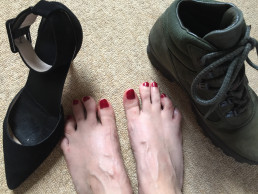
If the shoe doesn’t fit... orthotics and hip dysplasia
Walking my first 10K for Steps last month taught me a couple of valuable lessons. Firstly, I need to build up my leg strength, particularly around my knees, or I’ll never manage the hills and rugged terrain of the South Downs Way. And secondly, I need to find some comfortable walking boots that my orthotics fit into properly, so I don’t get blisters.
This second realisation makes my heart sink. Oh no, not shoes….
Shoes have always been my personal nemesis. Practically and emotionally.
I was born with hip dysplasia (DDH). My pelvis is incomplete, crooked and I have legs that are different lengths. I also inherited some ‘unusual’ feet that are different sizes - and a left ankle that turns out a bit like Mary Poppins. I wear orthotics to correct my leg length and knee position so practically speaking, pumps or shoes that are light and tie tightly to my feet are the best.
Emotionally – well, like many women I drool over the sexy heels on display in the LK Bennett window. But shoe shopping just isn’t fun. Unlike Cinderella, the shoe rarely fits on either foot and the need to insert orthotics writes most girl-shoes off the list. When it comes to dressing up girly, I often feel more like the ugly sister than the fabled princess in waiting.
I didn’t mind shoe shopping as a kid. My orthopaedic consultant insisted on good shoes that fastened well to my feet so we always went to Clarks in the Co-op department store in Sheffield. They had animated models of the Animal Kwackers there, who I loved. Like Boots and his silver platforms there was a blingster in young Jill - so I always chose the shiny shoes with gold braiding. Happy memories.
The psychological challenges started for me as a teenager. Wearing stilettos was a marker that you were growing up and at that age I become hyper-conscious of the image that heels = sexy. So I persevered with my heels and fishnets at school (it was the 80s in a school with no uniform) because I wanted to fit in. And I wanted boys to look at me like they did the other girls. In reality heels just accentuated my limp and made me walk badly because they’re less stable.
Yet to this day I still dread dressing up for a night out where women wear sexy high heels with their dresses. My own inability to stand up, let alone walk or dance in them, makes me feel like I'm not quite cutting it as a woman. Of course, this is just my own perception - a story I've invented in my own head. But it’s honestly what goes on in it! Rationally I know it really doesn’t matter and I’m lucky I can walk. But emotions are funny things….
I was recently with a group of girlfriends who were sharing their first childhood memories. Ironically, mine is about shoes. My pre-school playgroup used to streamline the rush for bags and coats at the end of the morning, by sending you to get them according to shoe colour. “Everyone with red shoes. Now everyone with brown shoes.” It’s a happy memory for me because I got to go up on my own. I was the only one in blue shoes and I simply loved that I was different. I was differently-abled and differently-minded.
Thankfully stilettos aren’t the rage along the South Downs Way. So right now it’s about finding boots that can support but not cripple my funny ankles. And getting good orthotics that are fitted properly inside them. Since my 10K I’ve been consulting with a chiropractor and my podiatrist, and I’m being fitted for new orthotics next week.
The more I explore my life with hip dysplasia (DDH) and what goes on in my mind about that, the more I see that we’re all differently-abled. We all have things we’re not good at or a bit paranoid about. And let’s face it, you don’t need to have hip dysplasia to be crap at walking in heels!
My pledge is to try and be more like 3-year-old Jill - newly walking in her blue shoes. Walking differently. And proud of it.